
Quick verdict: Tidio is most relevant for small ecommerce teams that want live chat, ticketing, automation, AI assistance, and Shopify-related support functions in the same evaluation. Its billing shape requires separate attention to support conversation allowances and AI conversation allowances. Teams should assess both expected human-support demand and automated-resolution demand before deciding whether the model is a good fit.
Research basis: official Tidio pricing, billing, product and integration documentation. This guide does not claim direct product testing.
Who Tidio Pricing Is Best For
- Small ecommerce teams that need to compare human support usage with AI-assisted resolution usage.
- Stores looking for live chat, ticketing, flows and automation, and an AI agent within the same support evaluation.
- Shopify teams that want support software with Shopify capability and order-management functionality.
- Teams able to monitor two distinct usage drivers instead of evaluating cost through a single support metric.
Who Should Compare Other Pricing Models
- Teams seeking a pricing assessment based on one combined usage measure.
- Businesses that cannot estimate whether support demand will be handled mainly through human conversations or AI resolutions.
- Teams that need unsupported assumptions about plan limits, overages, or included features to make the decision; those details require separate verification.
How Tidio Billing Works
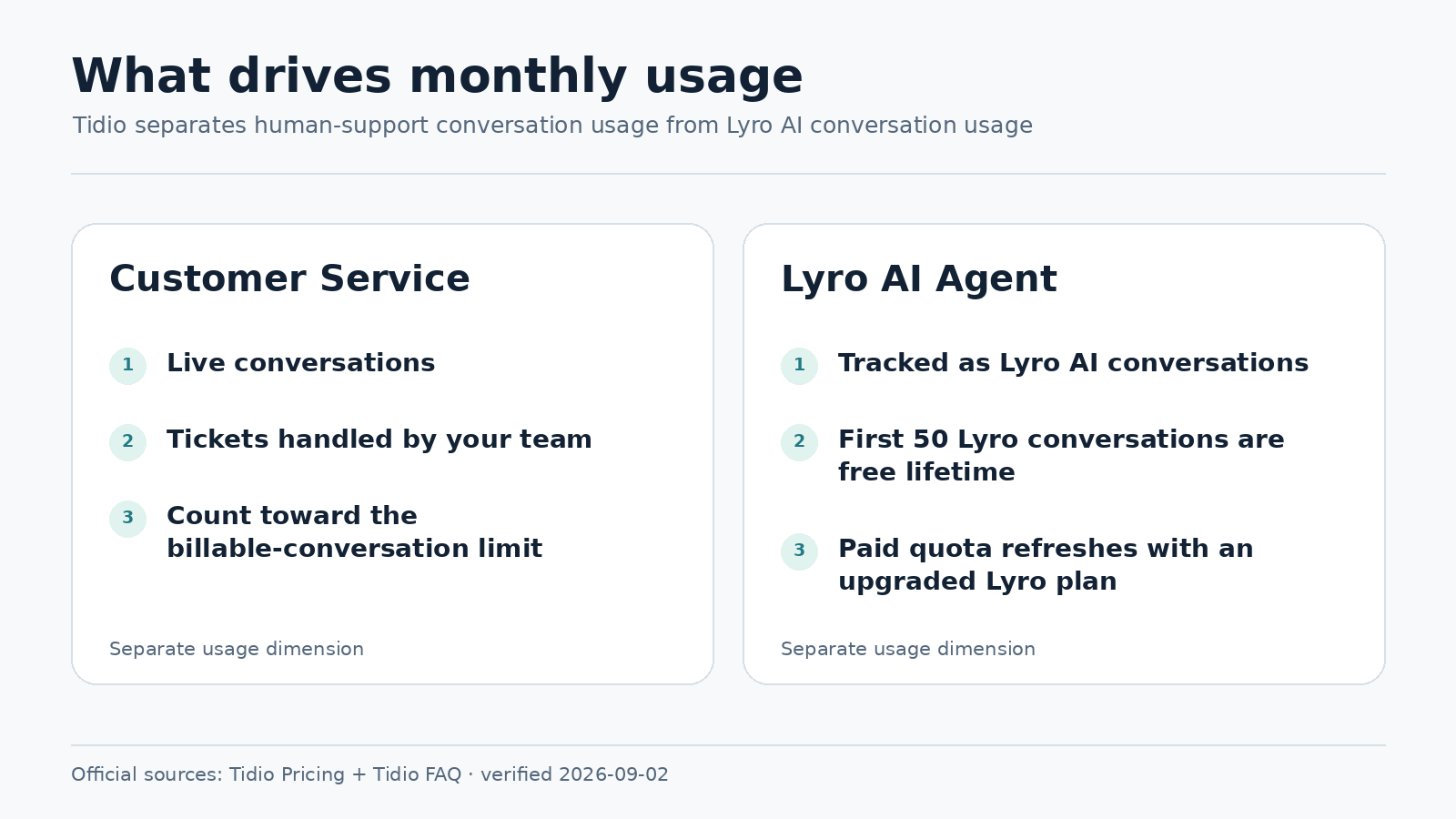
The key pricing consideration is the separation between support conversation allowances and AI conversation allowances. Those allowances can act as distinct cost drivers, so a team may need to forecast two kinds of demand rather than one. Human-led support activity affects the support conversation side, while automated assistance affects the AI conversation side. Predictability therefore depends on how clearly the team understands its expected support mix. A store with uneven demand, expanding automation, or changing customer-service practices should review both drivers and identify which one is more likely to shape ongoing spend. The model is easier to assess when the team separates routine support volume from AI-assisted resolution volume before comparing plans.
Verified Pricing Snapshot
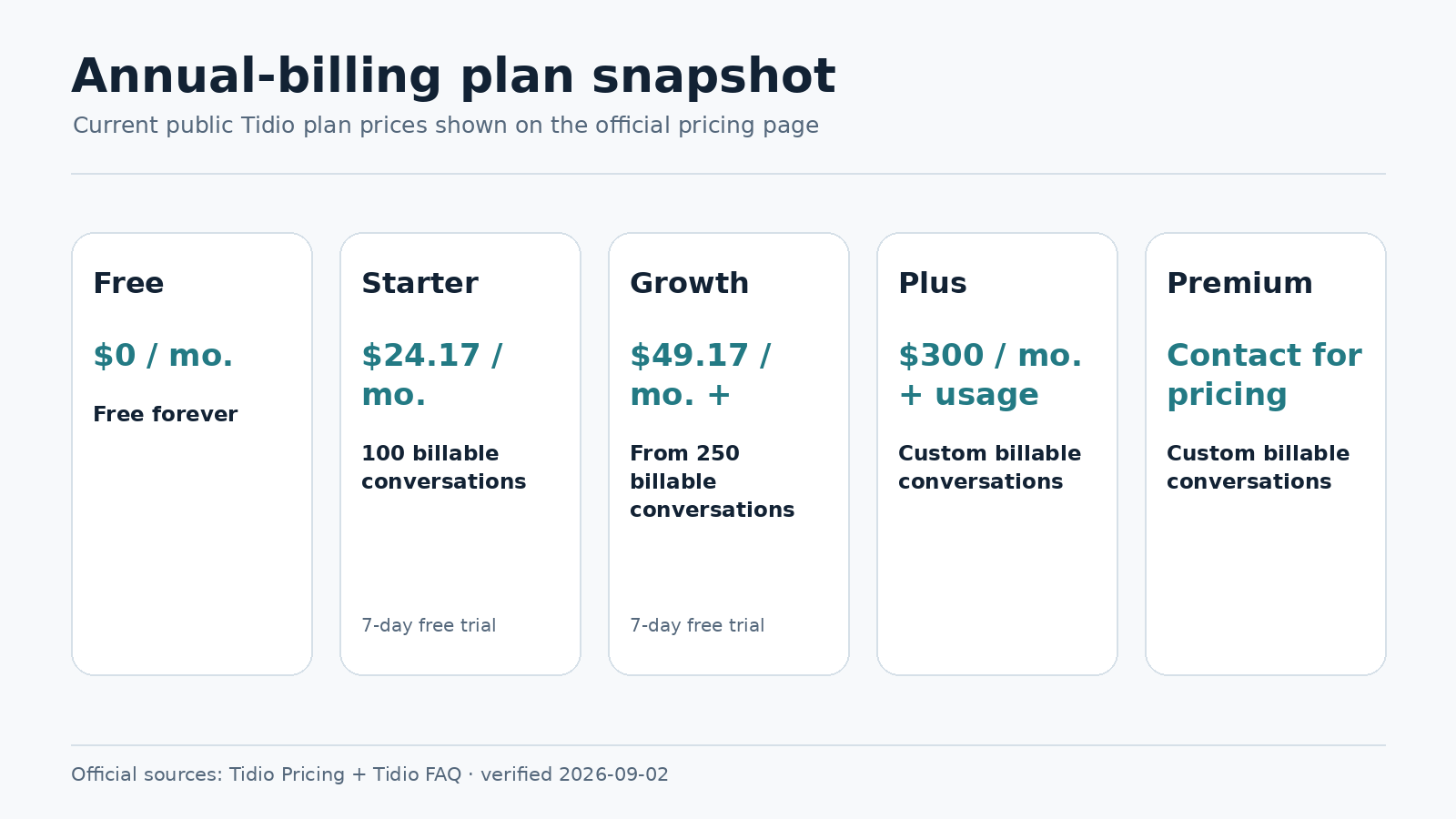
Primary-source check: Tidio’s official pricing page was re-verified on 2026-08-30. Pricing can change, so treat this as a dated snapshot.
| Option | Current starting point | Usage note |
|---|---|---|
| Free | $0/month | Entry plan |
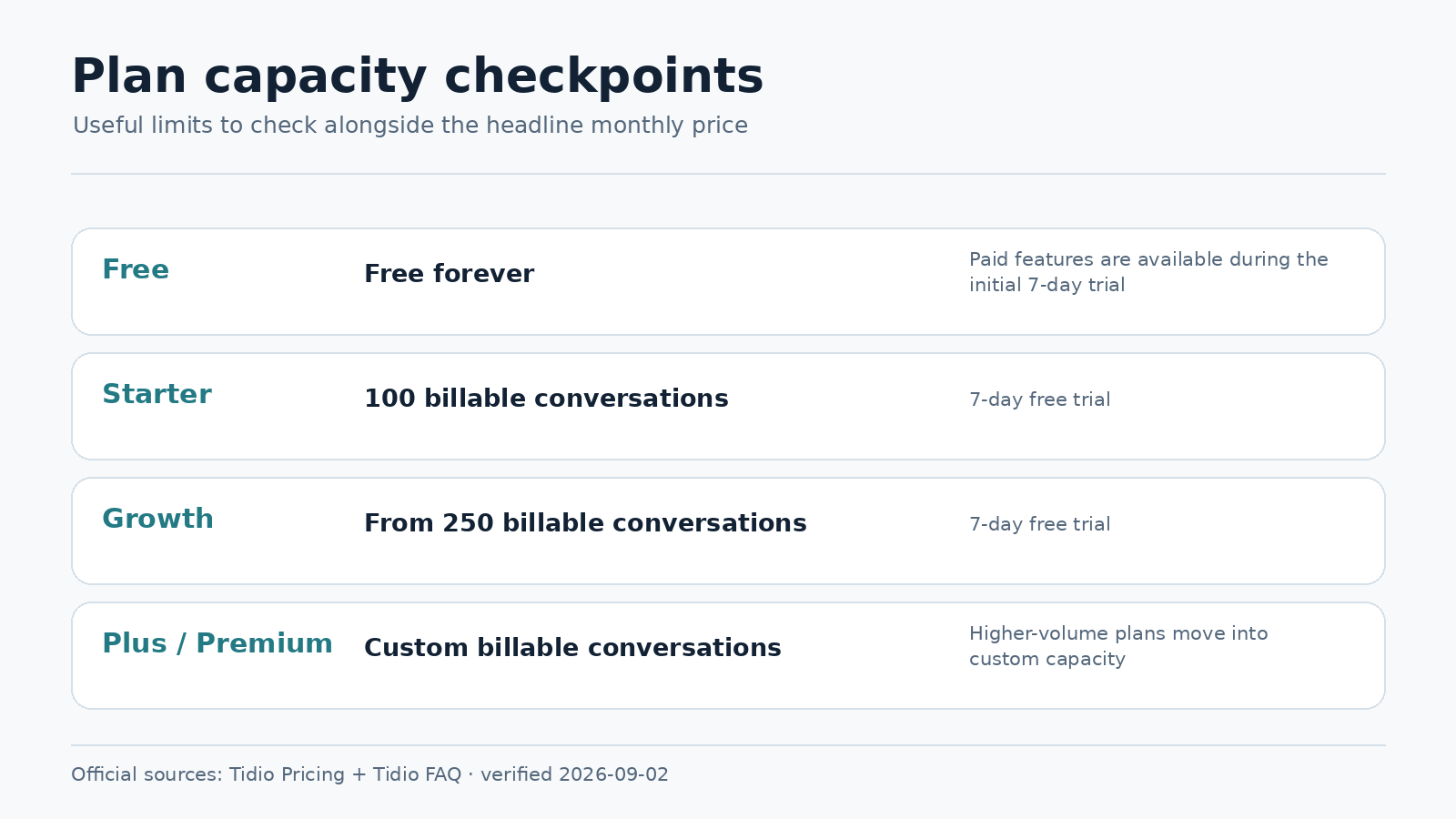
| Starter | $24.17/month on annual billing | 100 billable conversations |
| Growth | Starts at $49.17/month on annual billing | From 250 billable conversations |
| Plus | Starts at $300/month | Monthly usage is charged separately |
| Lyro AI Agent | Starts at $49.17/month | From 3000 Lyro AI conversations |
A 7-day free trial is listed for the paid entry paths above. The important budgeting point is that human-support usage and AI usage can be separate dimensions.
What the Product Includes
Tidio combines several support functions relevant to ecommerce operations. Its verified capabilities include live chat and ticketing for customer-support activity, flows and automation for structured interactions, and an AI agent for automated assistance. Shopify capability and Shopify order management make the product relevant to stores whose support work includes ecommerce order context. These capabilities describe the areas that should be included in an evaluation; they do not, by themselves, determine the final cost. The commercial question is how often customers enter support conversations and how often AI handles conversations as resolutions.
| Capability | Officially verified |
|---|---|
| Live chat | Yes |
| Ticketing | Yes |
| AI agent | Yes |
| Automation flows | Yes |
| Shopify integration | Yes |
| Shopify order management | Yes |
Ecommerce Workflow Fit
Tidio’s Shopify capability and Shopify order management make it relevant to an ecommerce workflow in which support work and order context need to be considered together. Live chat can represent immediate customer contact, ticketing can represent support cases that require organized follow-up, and flows and automation can structure recurring interactions. The AI agent adds another route for handling customer conversations. The supplied evidence confirms these capabilities, but does not establish the depth of any particular Shopify workflow or the conditions attached to each capability. A small team should therefore verify the exact operational fit alongside the pricing review, especially where order management is central to support work.
Practical Considerations: Main Cost Drivers
- The team should distinguish support conversations from AI conversations when forecasting demand.
- The pricing review should examine whether human support or AI resolution is the more important cost driver.
- Automation can change the balance between the two usage categories, so expected workflow design matters as much as current volume.
- Shopify relevance is supported by the product’s Shopify capability and order-management capability, but detailed workflow requirements still need confirmation before selection.
Alternatives With Different Cost Structures
- Gorgias belongs in the comparison when a team wants to evaluate a ticket-based helpdesk usage model against Tidio’s separate support-conversation and AI-conversation drivers. The supplied comparison context identifies helpdesk usage as ticket-based and AI usage as resolution-based. That difference gives teams a useful basis for comparing how each product frames support and AI demand, without assuming that either model will be less expensive for a particular store.
- LiveChat should also be included in the shortlist when a team is comparing support software costs. The supplied facts identify the product as an alternative name but do not provide verified pricing, billing, workflow, or capability details for it. A fair comparison should therefore confirm those points directly rather than infer them from the product name.
Bottom Line
Tidio’s main pricing decision is whether a small ecommerce team can forecast two separate forms of usage: support conversations and AI conversations. Its combination of live chat, ticketing, automation, AI assistance, Shopify capability, and Shopify order management gives the evaluation a clear ecommerce context. Teams that can map those capabilities to their expected support mix may find the model straightforward to assess. Teams that prefer a single usage lens, or that need detailed assumptions about limits and overages before comparing options, should place Tidio beside Gorgias and LiveChat and verify the relevant commercial details before choosing.