
Quick verdict: Small ecommerce teams centered on live conversations, social messaging, and automated shopping journeys should choose Tidio. Teams that need a more structured helpdesk—with shared ticket ownership, routing, service-level policies, reporting, and a knowledge base—should choose Freshdesk. The trade-off is workflow emphasis: Tidio organizes support around conversations and automation, while Freshdesk organizes it around broader helpdesk operations. Both provide ticketing, live ecommerce relevance through Shopify, and a path to combine human support with automation, but they suit different operating models.
Research basis: official Tidio and Freshdesk pricing, product and Shopify documentation. This comparison does not claim direct product testing.
Best For Tidio
- Small ecommerce teams that want live chat to sit at the center of customer support.
- Businesses handling conversations across channels including Instagram, Messenger, WhatsApp, and live chat.
- Teams that want flows and automation to guide common customer journeys before or alongside human assistance.
- Stores using Shopify or WooCommerce, particularly when Shopify order management is part of the support workflow.
Best For Freshdesk
- Small ecommerce teams building a formal helpdesk around tickets and a shared inbox.
- Support operations that need intelligent routing, multiple service-level policies, and reporting or analytics.
- Teams that want a knowledge base alongside agent-handled support.
- Shopify businesses that need support context spanning order information, payment, shipping, or multiple stores.
Core Differences
Tidio is the more conversation-oriented option. Its supplied capabilities place live chat, social messaging, flows, and automation close to the center of the support experience, with ticketing available as part of that setup. Freshdesk is the broader helpdesk option in this comparison. Its supplied capabilities combine ticketing and a shared inbox with intelligent routing, multiple service-level policies, analytics and reporting, and a knowledge base. That makes the central choice less about channel count and more about how the team wants work organized: around active conversations and automated flows, or around structured case management and support operations.
| Decision lens | Tidio | Freshdesk |
|---|---|---|
| Core support workspace | Live chat and ticketing | Ticketing and shared inbox |
| Shopify integration | Verified | Verified |
| Ecommerce order context | Shopify order management verified | Order, payment and shipping context verified |
| Multiple Shopify stores | Not evaluated in this evidence set | Verified |
| Knowledge base | Not evaluated in this evidence set | Verified |
| Routing and SLA controls | Flows automation verified; broader service-policy controls were not evaluated in this evidence set | Intelligent routing and multiple SLA policies verified |
| AI layer | Lyro AI Agent verified | AI Agent sessions and Copilot pricing verified |
How the Billing Models Differ
The billing shapes reflect the products’ different operating models. Tidio separates human-support billing, which follows billable conversations, from AI usage as a separate cost driver. Freshdesk’s core helpdesk plans follow agent count, while AI capacity can introduce separate usage or agent-based cost drivers. A buyer should therefore map the expected support motion before comparing commercial fit: a conversation-led team should examine how its interaction volume aligns with Tidio’s structure, while an agent-led helpdesk should examine staffing and AI requirements under Freshdesk’s structure. The supplied facts do not establish which model will cost less for a particular team.
Verified Pricing Snapshot
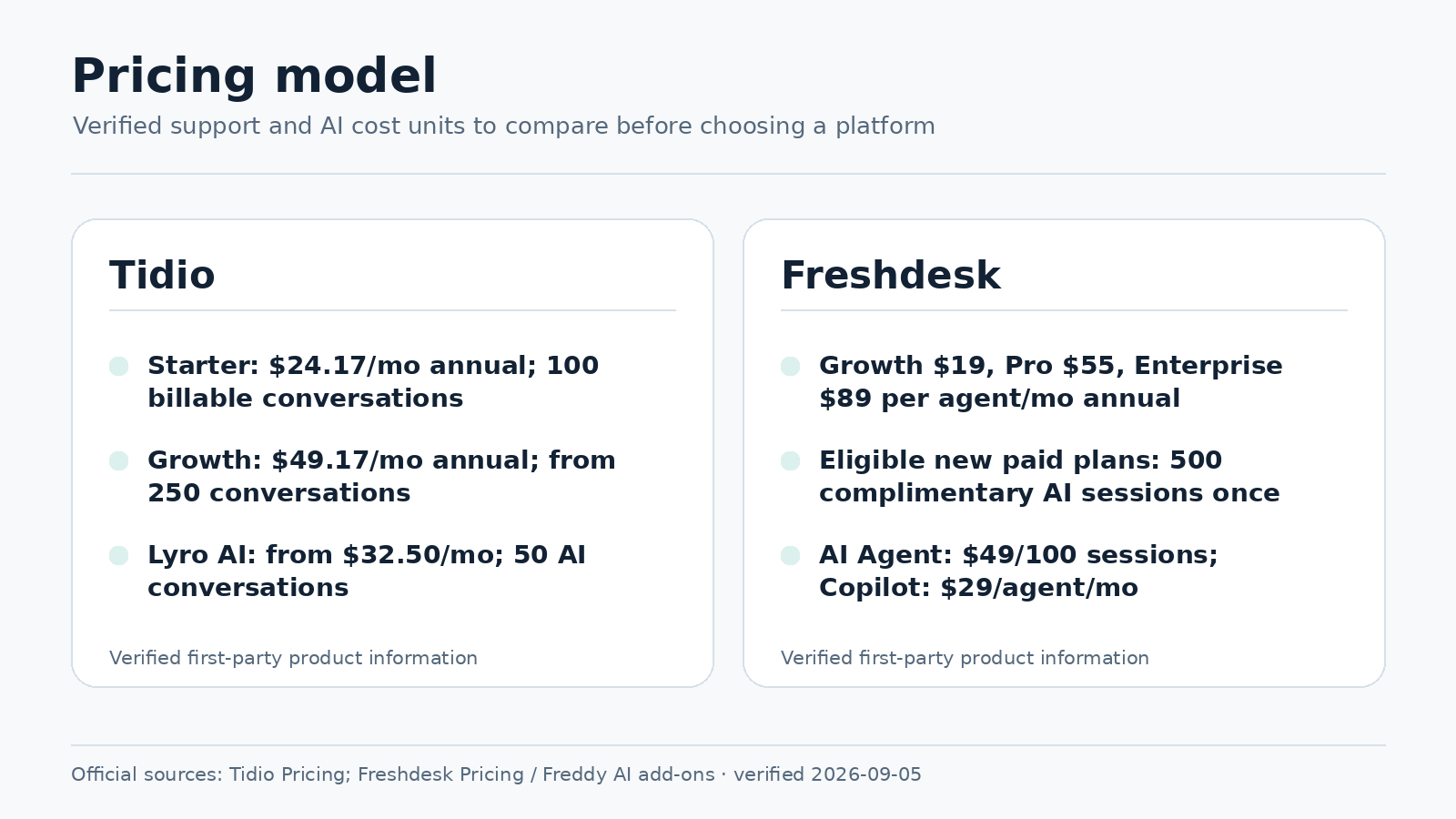
Primary-source check: Official Tidio and Freshdesk pricing and product documentation was re-verified on 2026-09-05. Pricing can change, so treat this as a dated snapshot.
| Product area | Verified snapshot | Buyer note |
|---|---|---|
| Tidio Free | $0/month | Entry plan |
| Tidio Starter | $24.17/month on annual billing | 100 billable conversations |
| Tidio Growth | Starts at $49.17/month on annual billing | From 250 billable conversations |
| Tidio Plus | Starts at $300/month | Monthly usage charged separately |
| Tidio Lyro AI Agent | Starts at $32.50/month | From 50 Lyro AI conversations |
| Tidio trial | 7 days | Official pricing path |
| Freshdesk Growth | $19 per agent/month on annual billing | Seat-based helpdesk plan |
| Freshdesk Pro | $55 per agent/month on annual billing | Seat-based helpdesk plan |
| Freshdesk Enterprise | $89 per agent/month on annual billing | Seat-based helpdesk plan |
| Freshdesk included AI Agent sessions | 500 one-time complimentary sessions for new paid customers | Growth, Pro, and Enterprise eligibility |
| Freshdesk additional AI Agent sessions | $49 per 100 sessions | Separate AI usage cost |
| Freshdesk Freddy AI Copilot | $29 per agent/month | Separate agent-based AI cost |
| Freshdesk trial | 14 days | Official free-vs-paid documentation |
The pricing models are structurally different. Tidio separates conversation-based human support usage from AI usage, while Freshdesk combines per-agent helpdesk pricing with separate AI capacity or copilot cost drivers. Buyers should model their own team and workload.
Shopify and Ecommerce Workflow
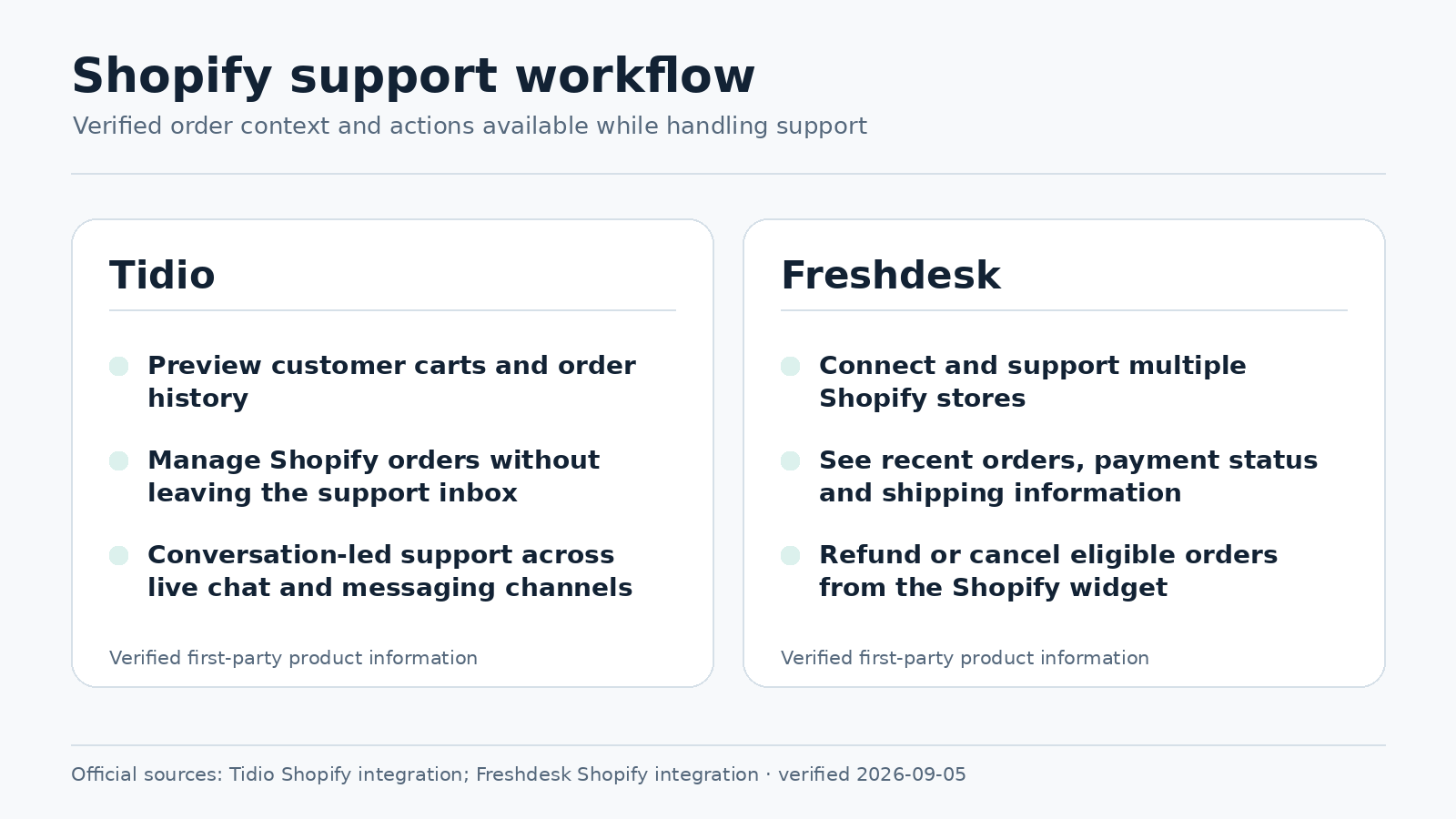
Tidio offers Shopify and WooCommerce support context, with Shopify order management included in the supplied capabilities. Its channel mix also suits stores that receive questions through live chat and social messaging. Freshdesk offers Shopify support with order information plus payment and shipping context, and it supports multiple Shopify stores. That distinction matters for operating complexity: Tidio aligns with conversational storefront support and order-related automation, while Freshdesk aligns with a helpdesk that brings store context into a more formal ticketing operation. Neither product should be selected solely from the store platform; the team’s service workflow remains the deciding factor.
AI and Automation
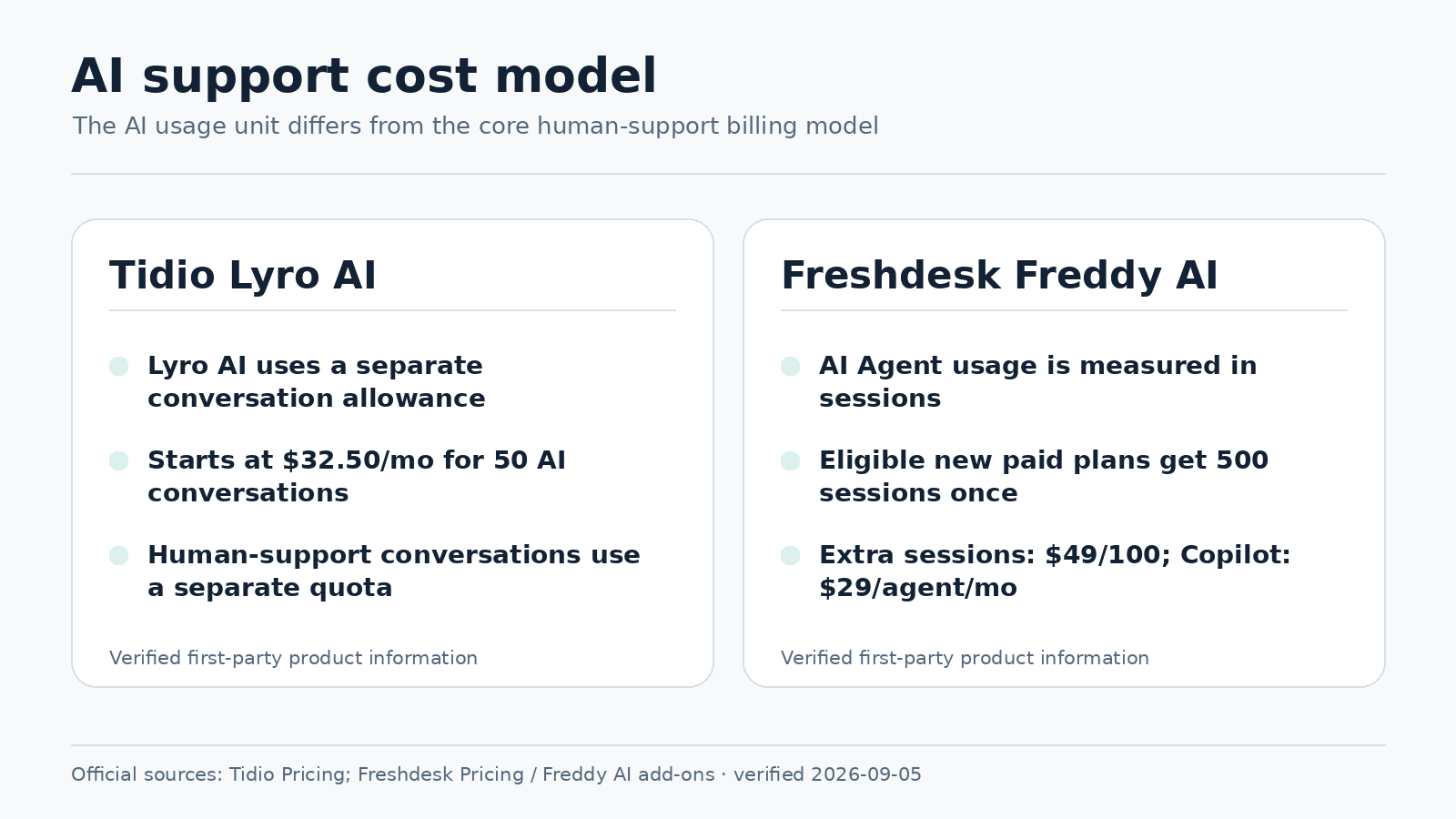
Tidio’s supplied AI structure includes an AI agent alongside flows and automation, making automated conversation handling a visible part of its support model. Freshdesk’s supplied facts identify AI capacity as a possible separate billing driver, while its operational strengths center on routing, policies, reporting, knowledge management, and ticket handling. The evidence supports a qualitative distinction, not a claim that either product can perform every possible AI task: Tidio foregrounds conversational automation, whereas Freshdesk places AI within a wider helpdesk framework.
What to Consider Before You Choose
- Whether most support begins in live chat or social messaging, or arrives as tickets requiring assignment and follow-up.
- Whether the team needs flows and an AI agent at the center of customer conversations, or routing, policies, reporting, and a knowledge base around human support.
- Whether Shopify order management is the priority, or whether payment, shipping, order, and multi-store context should feed a helpdesk workflow.
- Whether billable conversations or agent-based planning better matches the team’s support model, with AI treated as a separate cost consideration where applicable.
Bottom Line
Tidio is the clearer workflow fit for a small ecommerce team that wants conversational support and automation to lead the experience across storefront and messaging channels. Freshdesk is the stronger fit for a team formalizing support operations around tickets, shared ownership, routing, service-level policies, reporting, and documented answers. The buyer should choose the workflow shape first, then evaluate the corresponding billing structure and ecommerce context; the supplied facts do not support declaring a universal winner.