Quick verdict: Freshdesk is a fit for small ecommerce teams that want a conventional helpdesk foundation with ticketing, a shared inbox, knowledge base support, reporting, routing, service-level policies, and Shopify connectivity. Its cost model deserves closer review when AI adoption is expected, because AI can introduce separate session-based and agent-based cost drivers alongside the core agent-priced plans.
Research basis: official Freshdesk pricing, billing, product and integration documentation. This guide does not claim direct product testing.
Who Freshdesk Pricing Is Best For
- Small ecommerce teams that need a structured ticketing system and shared inbox.
- Teams that want Shopify-related order, payment, and shipping context available within support workflows.
- Support operations that need intelligent routing, analytics and reporting, a knowledge base, and multiple service-level policies.
- Teams that can forecast agent needs separately from possible AI sessions or AI agents.
Who Should Compare Other Pricing Models
- Teams seeking a single cost driver with no separate AI-related considerations.
- Businesses that cannot estimate how support staffing and AI usage may change over time.
- Buyers unwilling to compare Freshdesk’s billing shape with alternatives before selecting a support platform.
How Freshdesk Billing Works
The core billing shape is agent-priced, so the number and composition of support agents are primary cost drivers. AI can add a separate layer of session-based and agent-based cost drivers. That creates a model with two planning questions: how many people need access to the helpdesk, and how much AI activity or AI staffing will the operation use? This structure can be manageable when agent requirements and AI adoption are reasonably understood. It can be less predictable for a team whose staffing, customer demand, or use of AI is still changing. A careful evaluation should therefore separate recurring agent needs from potential AI-related usage before judging the overall fit. In the supplied comparison context, helpdesk usage is described as ticket-based while AI usage is described as resolution-based, reinforcing the need to examine what activity drives each part of the bill.
Verified Pricing Snapshot
Primary-source check: Freshdesk official pricing, plan and Shopify documentation was re-verified on 2026-09-02. Pricing can change, so treat this as a dated snapshot.
| Billing dimension | Verified snapshot | Buyer note |
|---|---|---|
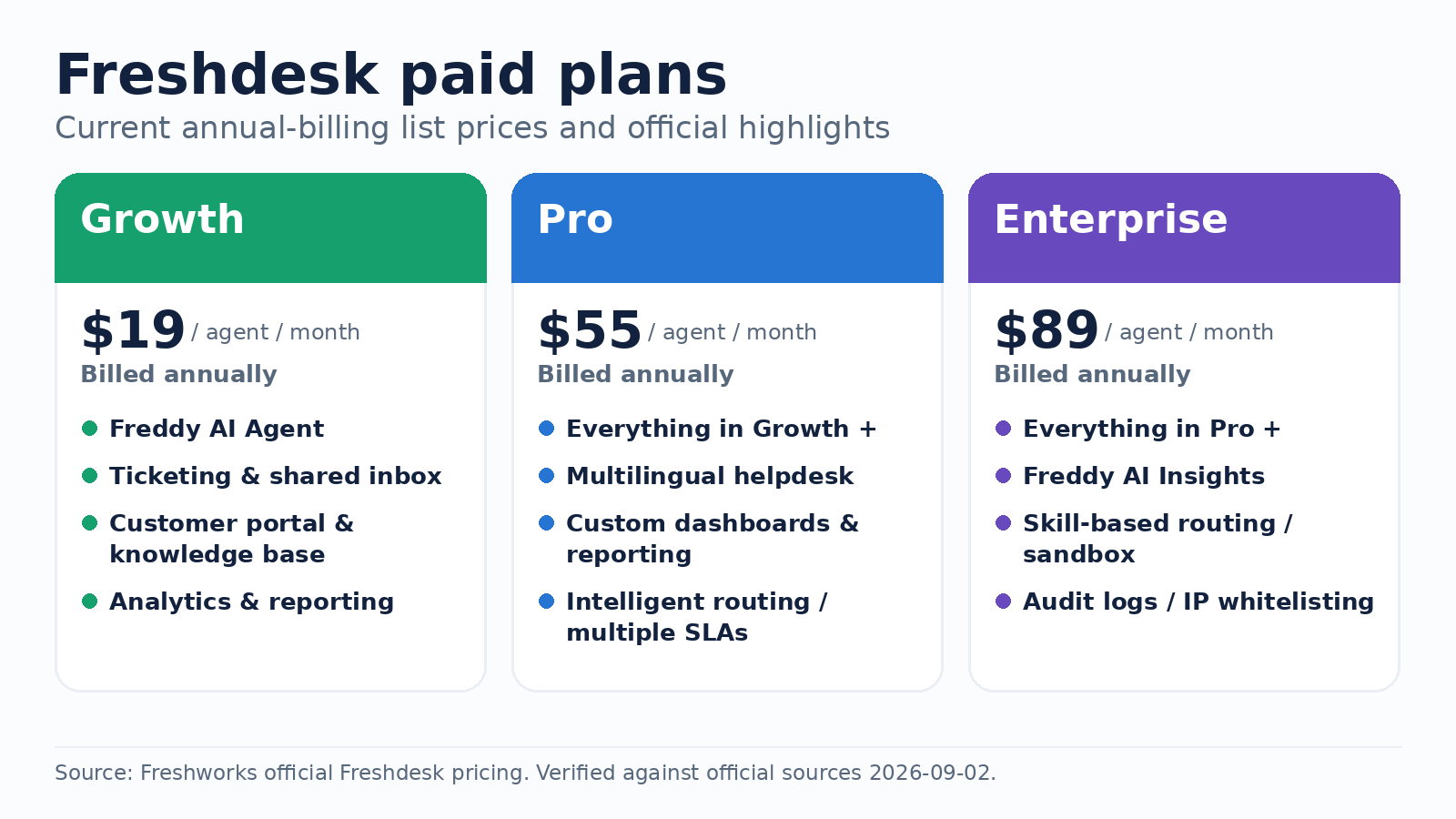
| Growth | $19 per agent per month, billed annually | Seat-based core helpdesk plan |
| Pro | $55 per agent per month, billed annually | Seat-based core helpdesk plan |
| Enterprise | $89 per agent per month, billed annually | Seat-based core helpdesk plan |
| AI Agent included capacity | 500 sessions | Included AI usage baseline |
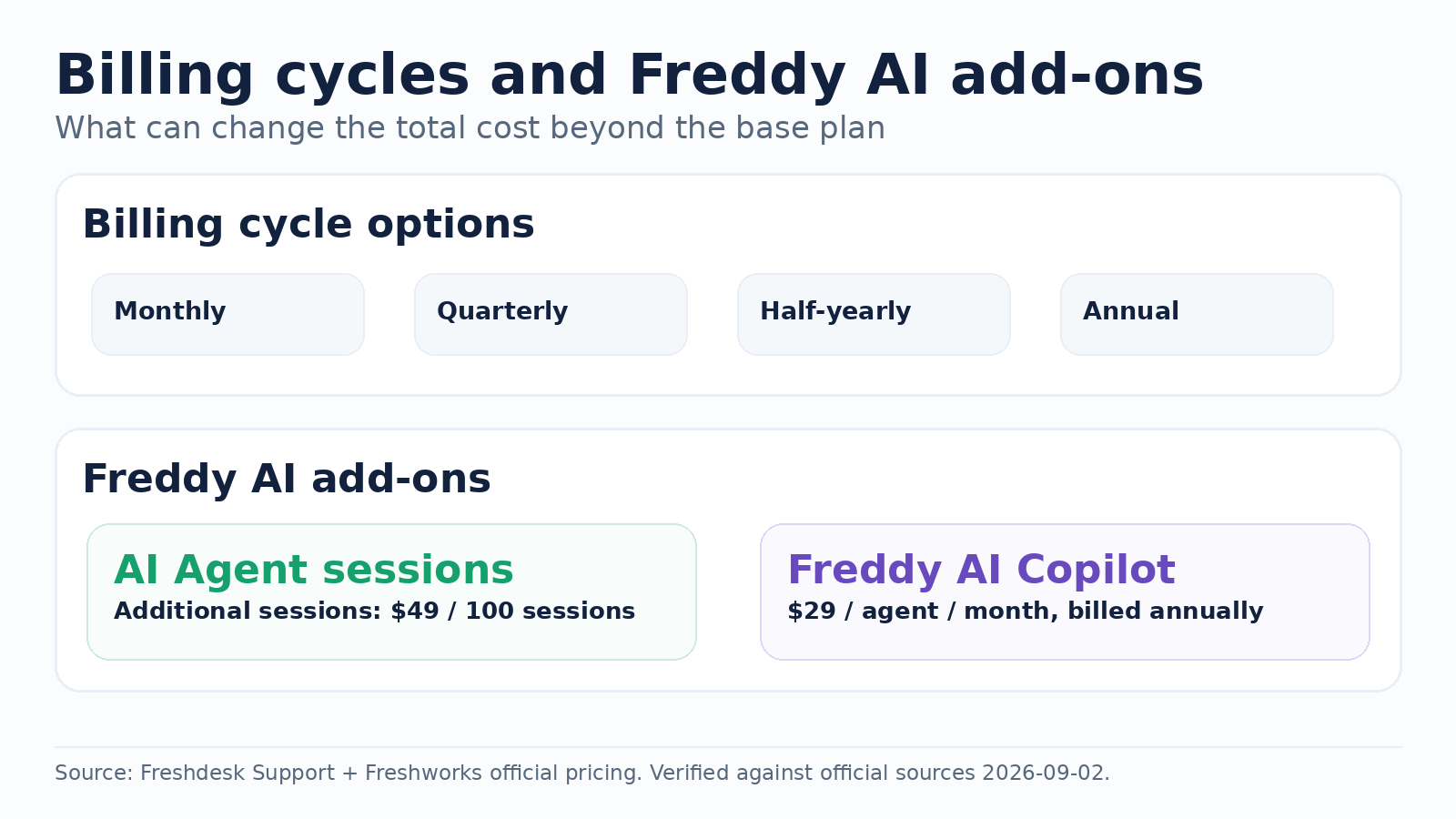
| Additional AI Agent sessions | $49 per 100 sessions | Usage-based AI expansion |
| Freddy AI Copilot | $29 per agent per month | Separate agent-based AI cost driver |
| Free trial | 14 days | Official plan documentation |
The core plans are agent-priced, while AI can add both usage-based sessions and an agent-based Copilot dimension. Teams should model support seats and AI adoption separately.
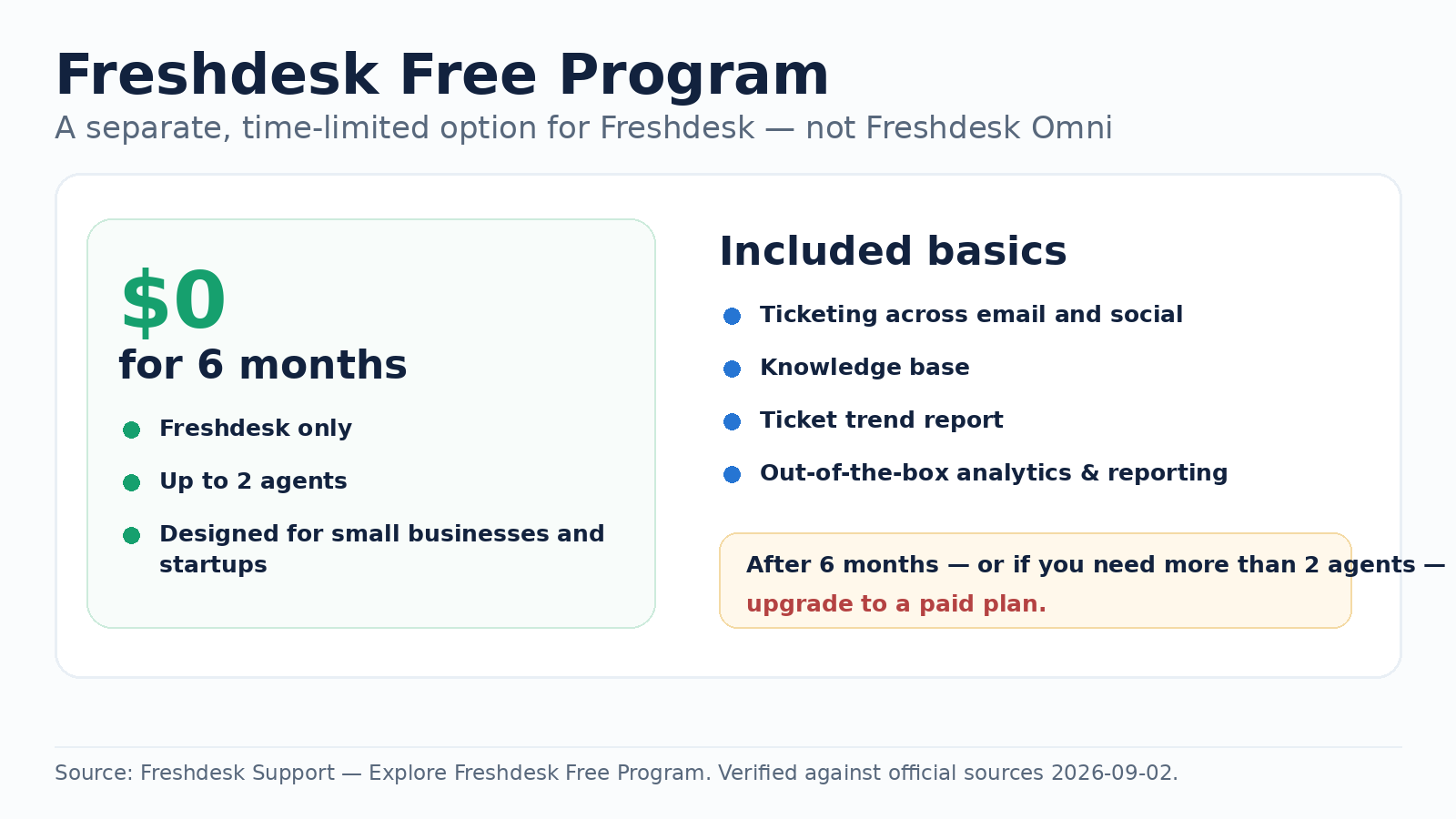
Offer distinction: The standard free trial and the separate Free Program are different offers, so evaluate them independently.
What the Product Includes
Freshdesk provides the core components of a helpdesk operation. Verified capabilities include ticketing and a shared inbox, giving a small team a central structure for handling customer support work. A knowledge base can support self-service content, while analytics and reporting can help the team review support activity. Intelligent routing is available for directing work, and multiple service-level policies support different service expectations within the operation. For ecommerce workflows, Freshdesk supports Shopify, including connections with multiple stores and access to Shopify order information as well as payment and shipping context. These capabilities make the product relevant to teams that want support work organized around customer issues while keeping important commerce context close to the helpdesk workflow.
| Capability | Officially verified |
|---|---|
| Ticketing | Yes |
| Shared inbox | Yes |
| Knowledge base | Yes |
| Analytics and reporting | Yes |
| Intelligent routing | Yes |
| Multiple SLA policies | Yes |
| Shopify integration | Yes |
| Multiple Shopify stores | Yes |
| Shopify order information | Yes |
| Shopify payment and shipping context | Yes |
Ecommerce Workflow Fit
Freshdesk’s Shopify fit is relevant to ecommerce teams that need support agents to work with commerce information rather than tickets in isolation. The verified Shopify capabilities include support for Shopify, multiple stores, order information, and payment and shipping context. That combination can suit a small operation handling customer questions across more than one storefront or dealing with issues where order, payment, or delivery context matters. The available facts establish workflow connectivity and context access, but they do not establish additional Shopify-specific automation or process behavior. Teams should therefore evaluate whether the verified connections cover the particular support workflow they need.
Practical Considerations: Main Cost Drivers
- Separate core helpdesk and AI cost drivers should be reviewed independently.
- Agent count is a central planning input for the helpdesk portion of the model.
- AI sessions and AI agents may affect cost differently from ordinary helpdesk activity.
- Teams should distinguish ticket-based support activity from resolution-based AI activity when comparing plans or vendors.
Alternatives With Different Cost Structures
- Gorgias should be included in a comparison when the team is assessing whether another support platform offers a more suitable billing shape or ecommerce workflow fit. The supplied facts do not establish further Gorgias capabilities, so the comparison should remain focused on verified pricing and workflow evidence.
- LiveChat should also be considered as a named alternative during the buying process. The available facts do not establish its features or billing details, so the team should compare it only on information verified for the specific support requirements and cost model under review.
Bottom Line
Freshdesk’s main appeal for a small ecommerce team is a broad helpdesk foundation paired with verified Shopify context and operational tools. The main decision point is billing structure: core costs follow agents, while AI can introduce session-based and agent-based drivers. Teams with stable staffing needs and a clear view of expected AI use may find that structure workable. Teams seeking maximum billing simplicity, or those still uncertain about support volume and AI adoption, should compare Freshdesk with Gorgias and LiveChat using verified facts before committing.