SE Ranking and Semrush now sit close enough on entry-level SEO pricing that headline cost is a weak tiebreaker. Capacity, research breadth, and the way each platform packages AI-search features matter more.
RIN Index put the same live site into both platforms, ran each audit, and checked the same commercial keyword. That gives a useful side-by-side view of workflow and output, but not a long-term accuracy benchmark.
Quick Verdict
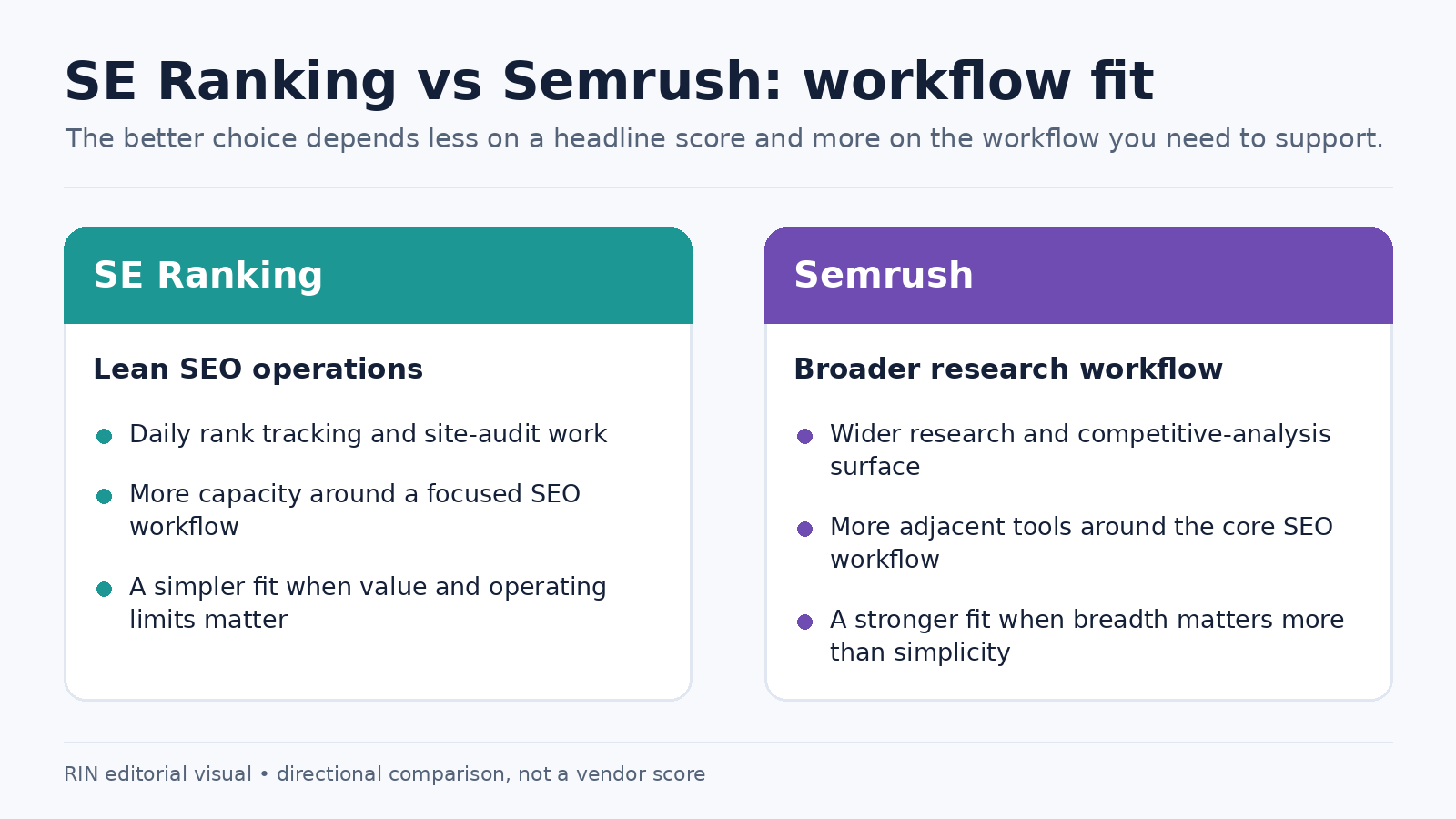
On the RIN Index test, both tools covered the core jobs, but they presented the next move differently. SE Ranking kept the path from an audit or keyword check to an action relatively direct, while Semrush exposed more context for investigating the market around that action.
SE Ranking vs Semrush at a Glance
| Decision lens | SE Ranking | Semrush |
|---|---|---|
| Value angle | Higher tracked-keyword and audit capacity in Core | Broader research ecosystem and product surface |
| SEO entry price | Core combines SEO and AI-search capacity | SEO has a lower entry path than the combined Starter bundle |
| Audit presentation | Errors, warnings and notices | Multiple health dimensions plus AI-search health |
| Best reason to choose | Capacity and value per plan | Breadth of research workflow |
Verified Pricing Snapshot
Primary-source check: Official pricing information was re-checked on 2026-09-06. Plans and limits can change, so confirm current checkout terms before buying.
| Plan | Monthly price | Annual equivalent | Selected capacity |
|---|---|---|---|
| SE Ranking Core | $129/month | $103.20/month | 10 projects; 2,000 tracked keywords daily; 250,000 audit pages per month; 100 AI prompts daily |
| Semrush SEO | $139/month on the current pricing page | $117.33/month | 5 websites; 500 tracked keywords daily; Site Audit included |
| Semrush Starter (SEO + AI Search) | $199/month | $165.17/month | 5 websites; 500 tracked keywords daily; 50 AI prompts daily |
Price alone does not separate these plans by much. The useful comparison is whether the included allowances match the workload and whether AI monitoring belongs in the same purchase. Features that rarely get opened should carry very little weight in a value calculation.
Semrush also separates its SEO entry plan from the combined SEO-and-AI Starter path. That packaging difference matters when comparing like with like.
Same-Site Comparison: The Live RIN Index Website
Both tools were configured for rinindex.com with the United States as the search market. The aim was to compare how each interface surfaces decisions from the same site, not to turn one score into a winner.
Site Audit Comparison
| Observed on RIN Index | SE Ranking | Semrush |
|---|---|---|
| Site health | 93 | 95 |
| Pages crawled | 27 | 33 |
| Error-class issues | 1 | 4 |
| Warning-class issues | 9 | 104 |
| Additional issue layer | 92 notices | Separate health dimensions |
| AI-search health | Not scored in this audit view | Shown as a separate health dimension |
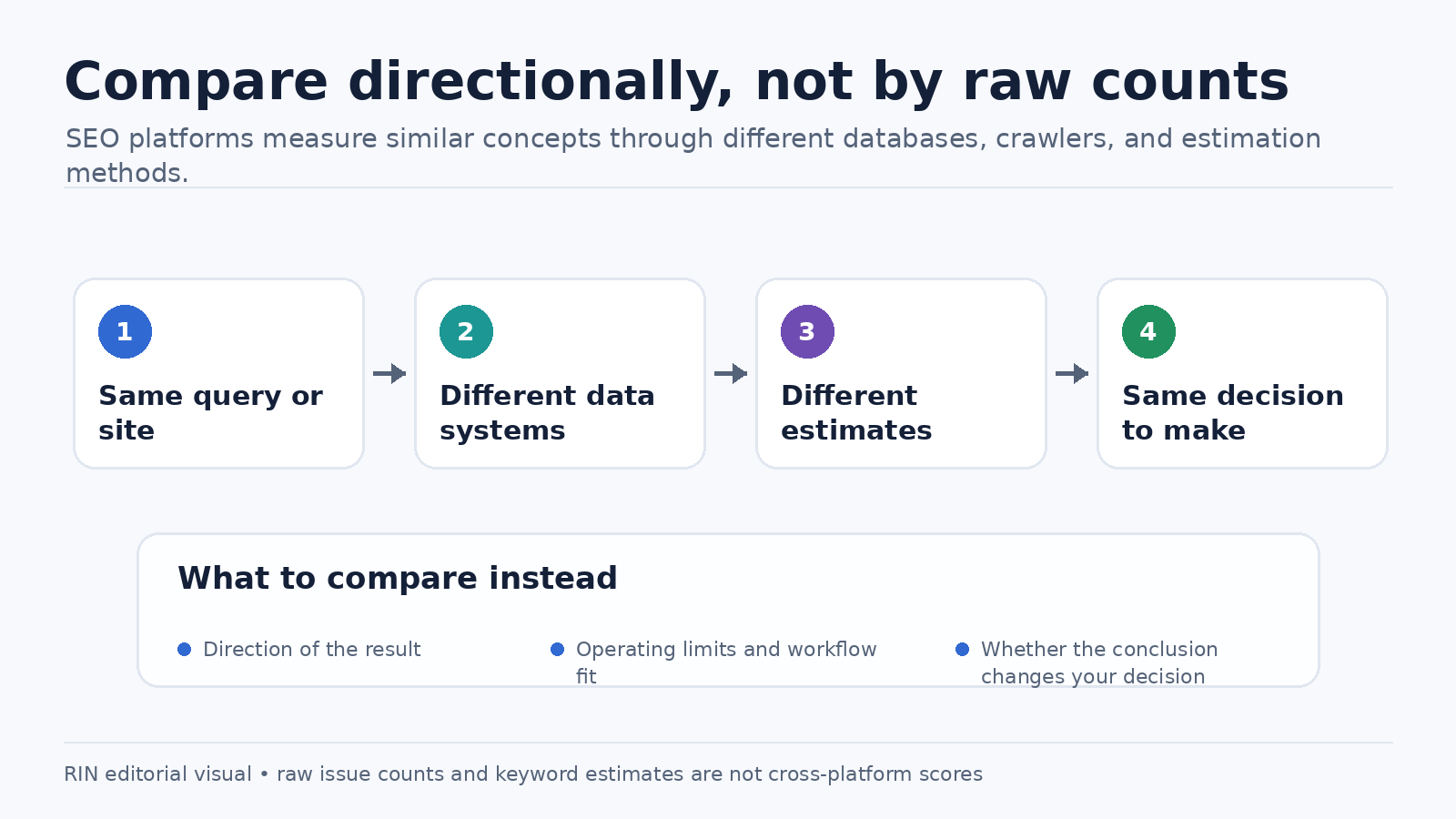
Raw issue totals are not directly comparable. The tools crawled different page counts and use different issue taxonomies, so a smaller number in one dashboard is not proof of a better crawler or a healthier site.
SE Ranking turns the crawl into a compact triage list, so the order of technical cleanup is quick to read. Semrush breaks site health into more diagnostic dimensions, giving a specialist more angles to investigate before choosing the next fix.
Keyword Research Comparison
| Same keyword: se ranking vs semrush | SE Ranking | Semrush |
|---|---|---|
| US search-volume estimate | 390 | 1,900 |
| Global volume | Not available in the observed result | 4,000 |
| Keyword difficulty | 15 | 28 |
| Intent | Informational | Commercial |
| CPC estimate | Available in the observed result | Available in the observed result |
| Competition | 0.18 | 0.23 |
The volume gap is a reminder that keyword platforms estimate demand rather than observe one universal search count. Difficulty and intent labels are tool-specific signals too.
The same query did not produce the same estimates in both databases. That is a reminder to use each dataset as a directional model rather than a verdict. For published pages, first-party search performance should eventually carry more weight than either forecast.
Rank Tracking
No long-term ranking experiment was run for this comparison. The useful evidence here is the current tracking workflow and plan capacity, not a claim about accuracy over time.
An editorial site can begin with a compact watchlist and add terms as new topic clusters are published. Capacity becomes noticeable when older keywords need to remain visible while fresh ones are added, so the useful allowance is the one that matches that growing list.
AI Search Features
SE Ranking Core includes a defined daily AI-prompt allowance. Semrush offers AI visibility across its product family and a clearer prompt allowance in the combined Starter plan, so AI packaging should be considered separately from traditional SEO limits.
AI visibility is packaged differently. SE Ranking keeps it close to the SEO workspace, while Semrush offers more than one entry path depending on how much of its surrounding suite the buyer wants.
Ease of Use
Navigation was the clearest usability difference during this test. SE Ranking grouped the path around a small set of core jobs; Semrush invited more exploration before settling on the screen needed for a particular task.
Who This Is For: Small Businesses
If one person owns content, search, and site maintenance, time spent hunting through menus is part of the tool’s real cost. SE Ranking suits that owner-operator setup because its core screens make it easier to keep a short weekly checklist moving. A small company with a dedicated marketer who spends substantial time studying competitors may get more mileage from Semrush.
SE Ranking is a stronger fit when:
- Owner-operators who want audit findings to become a short action list quickly.
- Growing sites that expect tracked terms and crawl usage to expand over time.
- SEO specialists who prefer fewer adjacent tools in day-to-day navigation.
Semrush is a stronger fit when:
- Marketers who investigate competitors before many content or campaign decisions.
- Strategists who want several discovery routes available without changing platforms.
- Agencies whose billable work includes market research as well as technical SEO.
Which Is Better for Agencies?
An agency selling standardized audit and reporting work will care about repeatable delivery and enough room for client workloads. A strategy shop that spends billable time on competitive discovery can benefit from Semrush’s larger research surface. The trade-off follows the service mix more than the size of the agency.
What to Consider Before You Buy
- Map the weekly workflow before comparing feature lists.
- Count the projects, pages, and tracked terms that must stay active together.
- Decide whether AI visibility needs to live beside traditional SEO work.
- Test the navigation with the person who will use the platform most often.
Bottom Line
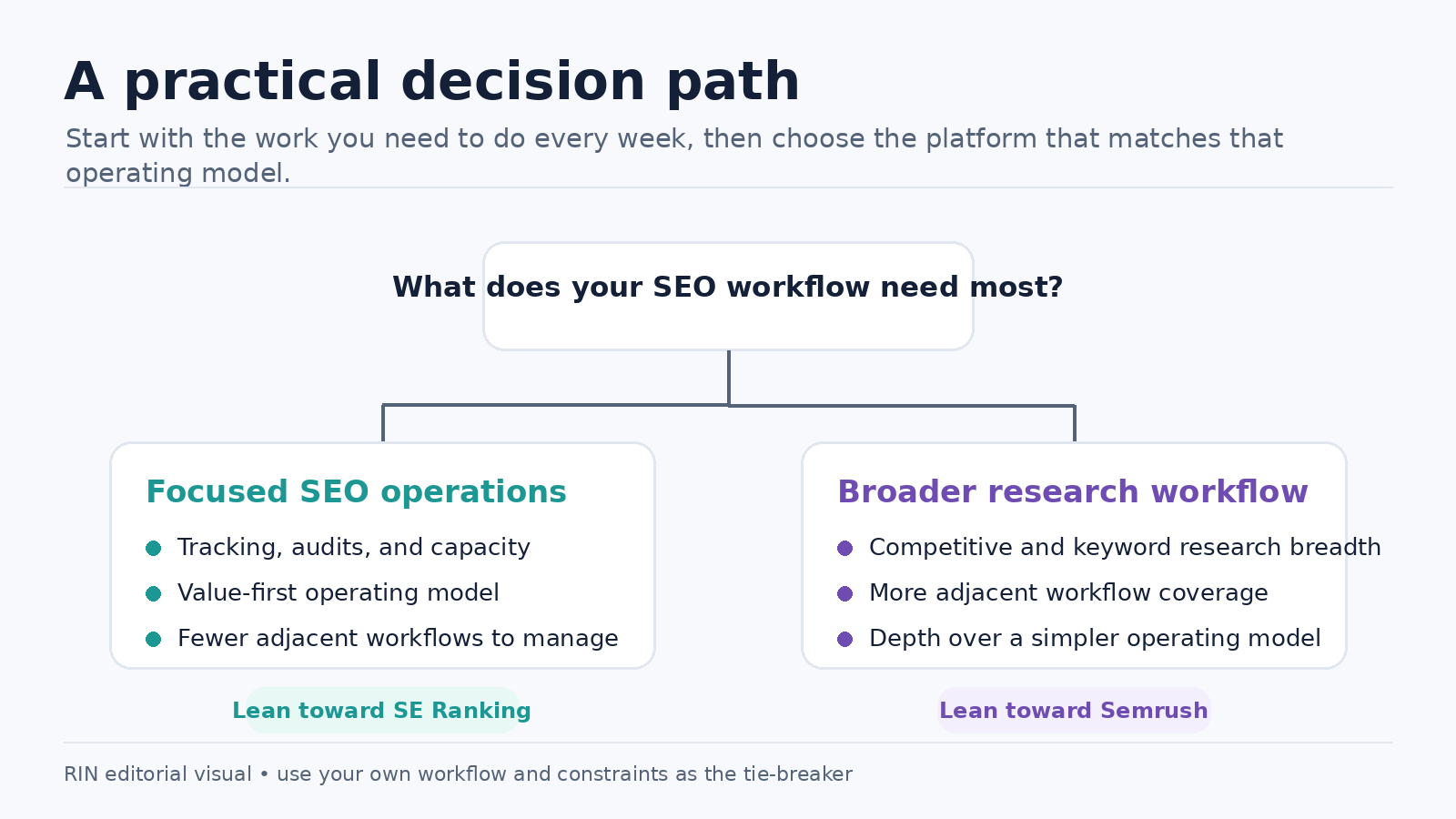
For RIN Index, the evidence points to SE Ranking because the site needs a direct operational workflow more than extra discovery routes. Semrush is easier to justify when competitive research is part of the job every week rather than a capability that might be useful later.
FAQ
Which tool has more accurate keyword data?
Neither keyword database is ground truth. Use estimates for consistent relative comparisons, then validate important choices with first-party search performance.
Which tool is easier for a beginner?
A beginner focused on audits, keywords, and tracking may orient faster in SE Ranking because fewer adjacent research areas compete for attention. Semrush becomes easier to appreciate once the user knows which research paths are actually needed.
Which tool offers better value?
The cheaper-looking plan is not automatically the better value. Compare what the active workload consumes, then discount features that will rarely be opened.