
Quick verdict: Tidio belongs on the shortlist for small ecommerce teams that need live chat, ticketing, automation flows, and an AI agent across Shopify, WooCommerce, messaging, and social channels. The main trade-off is billing complexity: human support usage and AI usage are tracked separately, so cost predictability depends on understanding both forms of usage. Tidio is less suitable for a team seeking a single, simple billing measure or a support platform selected primarily around agent-count pricing.
Research basis: official Tidio product, pricing, integration and help documentation. This is a research-based review and does not claim direct product testing.
Best For
- Small ecommerce teams consolidating live chat, ticketing, and messaging support in one service.
- Stores using Shopify or WooCommerce that want support capabilities connected to commerce operations.
- Teams interested in combining human assistance with an AI agent and automated flows.
- Businesses supporting customers through channels that include WhatsApp, Instagram, Messenger, and live chat.
Skip Tidio if
- Teams that want billing to be determined by one uncomplicated usage measure.
- Businesses that do not need ecommerce integrations, messaging channels, automation, or AI support.
- Buyers seeking a recommendation based on direct product testing or observed customer outcomes, since this review is limited to supplied primary-source-verified capabilities.
What Tidio Actually Does
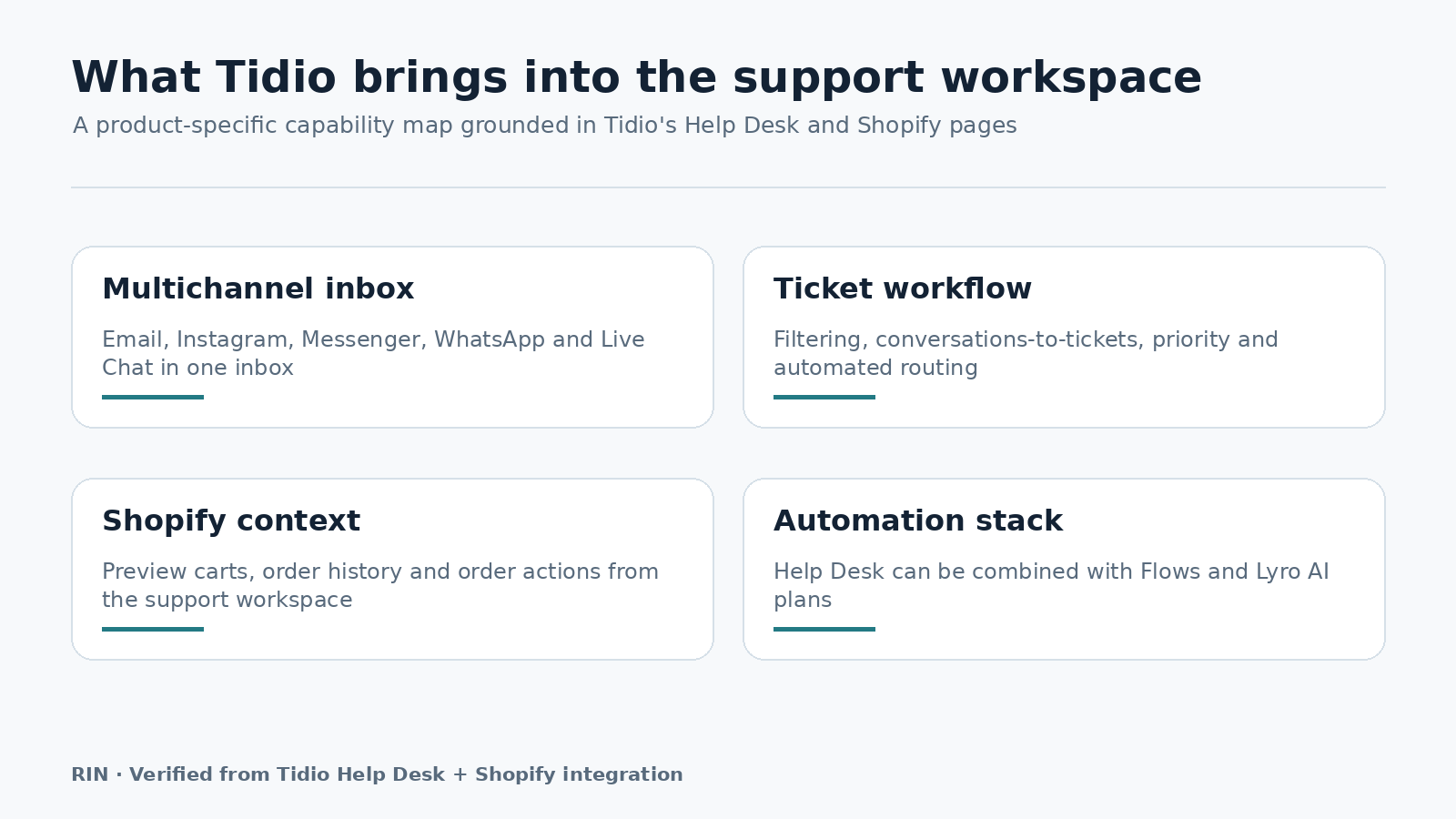
Tidio brings several customer-support functions into one ecommerce-oriented shortlist candidate. Its verified capabilities include live chat, ticketing, and automation flows, giving a small team ways to combine real-time conversations with more structured support handling. An AI agent is also part of the offering, while human support and AI usage remain distinct billing categories. The channel coverage is a material part of the case for Tidio. The platform supports Shopify and WooCommerce, along with WhatsApp, Instagram, Messenger, and live chat. That combination may reduce the need to assess separate tools for store-connected support and conversations arriving through social or messaging channels. Tidio also supports Shopify order management, which makes the Shopify connection more relevant than a basic storefront integration alone. The feature set points toward a blended support model rather than a tool limited to one interaction type. Teams can evaluate human support, automated flows, AI assistance, ticketing, and customer conversations across several channels as parts of the same buying decision. That breadth is useful, but it also means the shortlist decision should focus on workflow fit rather than feature count alone. A small team should identify which channels require active coverage and whether AI usage will be a meaningful part of support before treating the platform as a strong match.
| Buyer question | Verified | Evidence |
|---|---|---|
| Live chat | Yes | Official pricing/features |
| Ticketing | Yes | Official pricing/features |
| Lyro AI Agent | Yes | Official features |
| Flows automation | Yes | Official features |
| Shopify | Yes | Official features |
| WooCommerce | Yes | Official features |
| Shopify order management | Yes | Official documentation |
| WhatsApp, Instagram and Messenger | Yes | Official Shopify integration |
How the Pricing Model Feels in Practice
Tidio’s billing shape separates human support usage from AI usage. That distinction is important because the two categories can move independently: a team may have one pattern of staff-led support and another pattern of AI activity. The structure is therefore more usage-oriented than a single flat measure, and predictability depends on monitoring both sides of the account. This approach can suit teams that want human and automated support treated as distinct resources. It can be less comfortable for buyers who want an immediately simple forecast based on one count. Before choosing Tidio, a buyer should map expected support activity across human conversations and AI interactions, then confirm how each category affects the eventual bill. The supplied facts support a clear conclusion about billing structure, but not a claim about a specific total cost.
Verified Pricing Snapshot
Primary-source check: Tidio’s official pricing page was re-verified on 2026-08-30. Pricing can change, so treat this as a dated snapshot.
| Option | Current starting point | Usage note |
|---|---|---|
| Free | $0/month | Entry plan |
| Starter | $24.17/month on annual billing | 100 billable conversations |
| Growth | Starts at $49.17/month on annual billing | From 250 billable conversations |
| Plus | Starts at $300/month | Monthly usage is charged separately |
| Lyro AI Agent | Starts at $49.17/month | From 3000 Lyro AI conversations |
A 7-day free trial is listed for the paid entry paths above. The important budgeting point is that human-support usage and AI usage can be separate dimensions.
Shopify Fit
Tidio has verified Shopify support, including Shopify order management. That makes it a relevant candidate for stores where customer support needs to connect with commerce activity rather than remain separate from the storefront. The Shopify fit is especially useful when order-related support is part of the team’s regular workload. WooCommerce support is also verified, giving the platform broader relevance for small ecommerce teams that do not use Shopify. The available facts do not establish the depth of every workflow, so buyers should validate the exact store processes that matter most before committing.
What to Consider Before Choosing Tidio
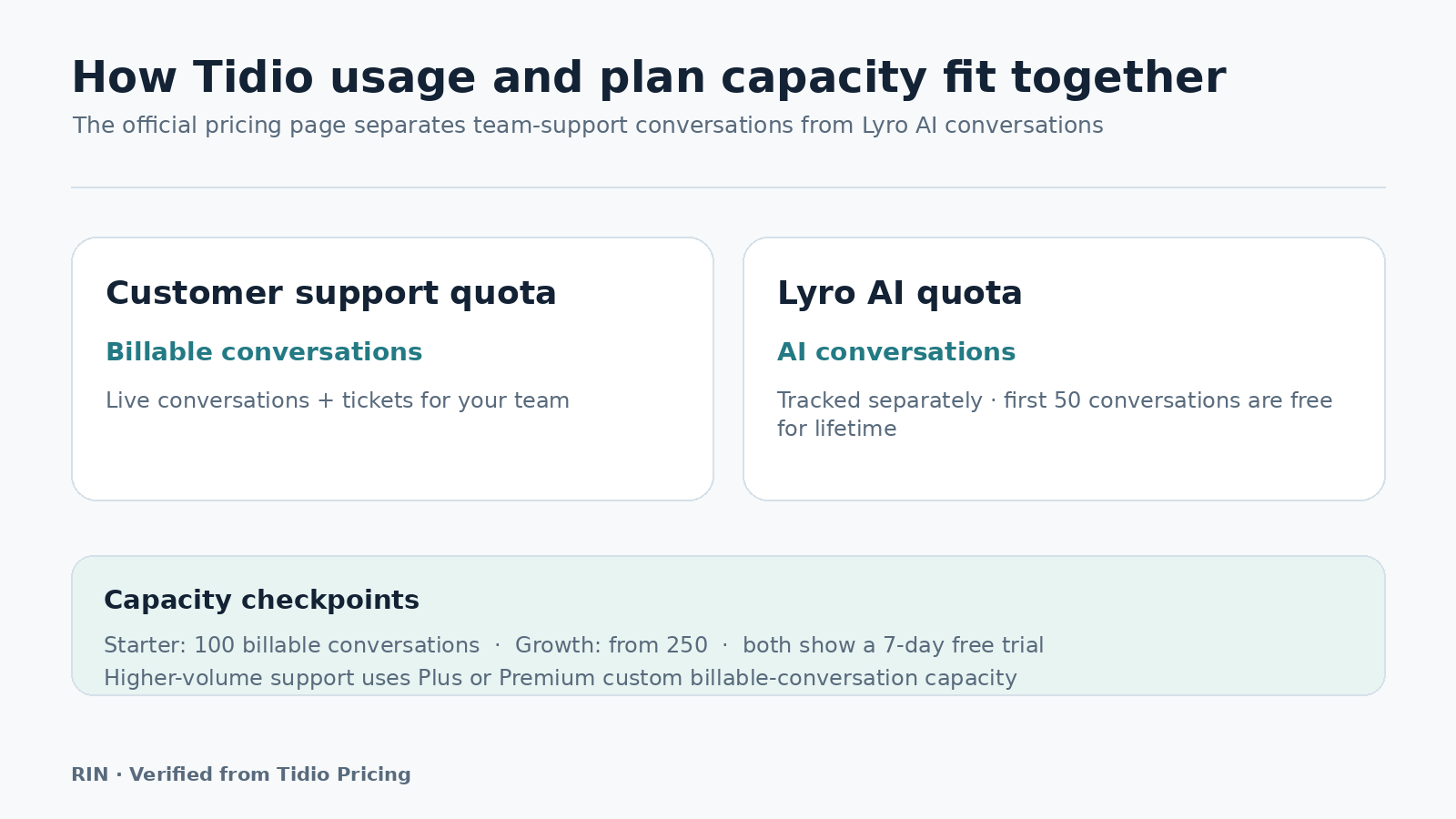
- The separate tracking of human support and AI usage should be treated as a central buying consideration, not a minor pricing detail.
- Channel breadth is valuable only if the team intends to support the listed channels; otherwise, the wider feature set may add evaluation complexity without changing the decision.
- Shopify order management strengthens the case for Shopify-based stores, while the supplied information does not establish equivalent order-management detail for WooCommerce.
- Automation flows and an AI agent create more ways to handle support, but the right balance between automation and human assistance will depend on the team’s operating model.
Alternatives to Compare
- Gorgias is a relevant comparison when the buyer is evaluating AI support alongside ecommerce helpdesk billing. The supplied comparison context verifies Shopify and Shopify order management, while its helpdesk usage is ticket-based rather than agent-count based and AI resolution billing is separate. That gives Gorgias a different billing shape from Tidio’s separately tracked human support and AI usage. The available facts do not support a broader feature comparison.
- LiveChat should remain on the comparison list because it is a named alternative for this purchase decision. However, the supplied facts provide no verified capabilities or billing details for LiveChat, so they do not support a meaningful feature, integration, or value judgment against Tidio. It should be assessed using the same criteria: required channels, ecommerce connections, automation, AI usage, and billing predictability.
Bottom Line
Tidio is a sensible shortlist option for small ecommerce teams that need a combined support stack spanning chat, ticketing, automation, AI, commerce platforms, and several messaging channels. Its clearest strengths are breadth and the verified Shopify connection, including order management. Its clearest caution is the split between human support usage and AI usage in billing. Buyers should choose Tidio when that operating model matches the team’s needs and when both usage categories can be forecast with reasonable confidence. Teams wanting simpler billing logic, fewer channels, or a platform judged on a different support model should keep comparing rather than treating Tidio as the default choice.