
Quick verdict: A small ecommerce team centered on Shopify support and a ticket workflow should choose Gorgias when it wants helpdesk usage tied to ticket volume and AI usage tied to successful autonomous resolutions. A team that needs a broader documented mix of ecommerce platforms, social channels, live chat, FAQ, and workflow automation should choose Re:amaze, while accounting for its user-based or conversation-volume billing structure and separate AI-resolution overage. The trade-off is between Gorgias’s more specifically described ticket-and-resolution alignment and Re:amaze’s broader documented workflow and channel context.
Research basis: official Gorgias and Re:amaze pricing, product, ecommerce, and Shopify documentation. This comparison does not claim direct product testing.
Best For Gorgias
- Shopify-focused teams that need Shopify order management within an ecommerce support workflow.
- Teams that want an omnichannel inbox paired with a helpdesk usage model based on ticket volume.
- Teams evaluating AI through the lens of successful autonomous resolutions rather than only agent access.
- Support operations that prefer billing concepts tied to tickets and autonomous resolution outcomes.
Best For Re:amaze
- Teams that need documented support across Shopify, BigCommerce, and WooCommerce contexts.
- Teams that want an omnichannel inbox alongside live chat, social channels, and FAQ capabilities.
- Teams that need workflow automation as part of the support operation.
- Teams comparing user-based planning with a conversation-volume approach and separate AI-resolution overage.
Core Differences
The central difference is workflow emphasis. Gorgias is described around an omnichannel helpdesk, Shopify order management, ticket volume, and successful autonomous resolutions. Re:amaze is also described around an omnichannel inbox, Shopify order management, and an AI agent, but the supplied evidence adds FAQ, live chat, social channels, workflow automation, BigCommerce, and WooCommerce. For a small team, that makes Gorgias the more directly aligned option when the support desk is primarily a Shopify ticket operation, while Re:amaze is the stronger candidate when the operating model spans more documented channels, platforms, and workflow components. The evidence does not establish that either platform lacks capabilities outside these descriptions.
| Decision lens | Gorgias | Re:amaze |
|---|---|---|
| Core support workspace | Omnichannel inbox | Omnichannel inbox |
| Shopify integration | Verified | Verified |
| Shopify order work | Order management verified | Order management verified |
| Other ecommerce platforms | Not evaluated in this evidence set | WooCommerce and BigCommerce verified |
| Live chat and social channels | Not evaluated in this evidence set | Live chat and social channels verified |
| Self-service and workflows | Not evaluated in this evidence set | FAQ and workflow automation verified |
| AI layer | AI Agent verified | AI Agent verified |
How the Billing Models Differ
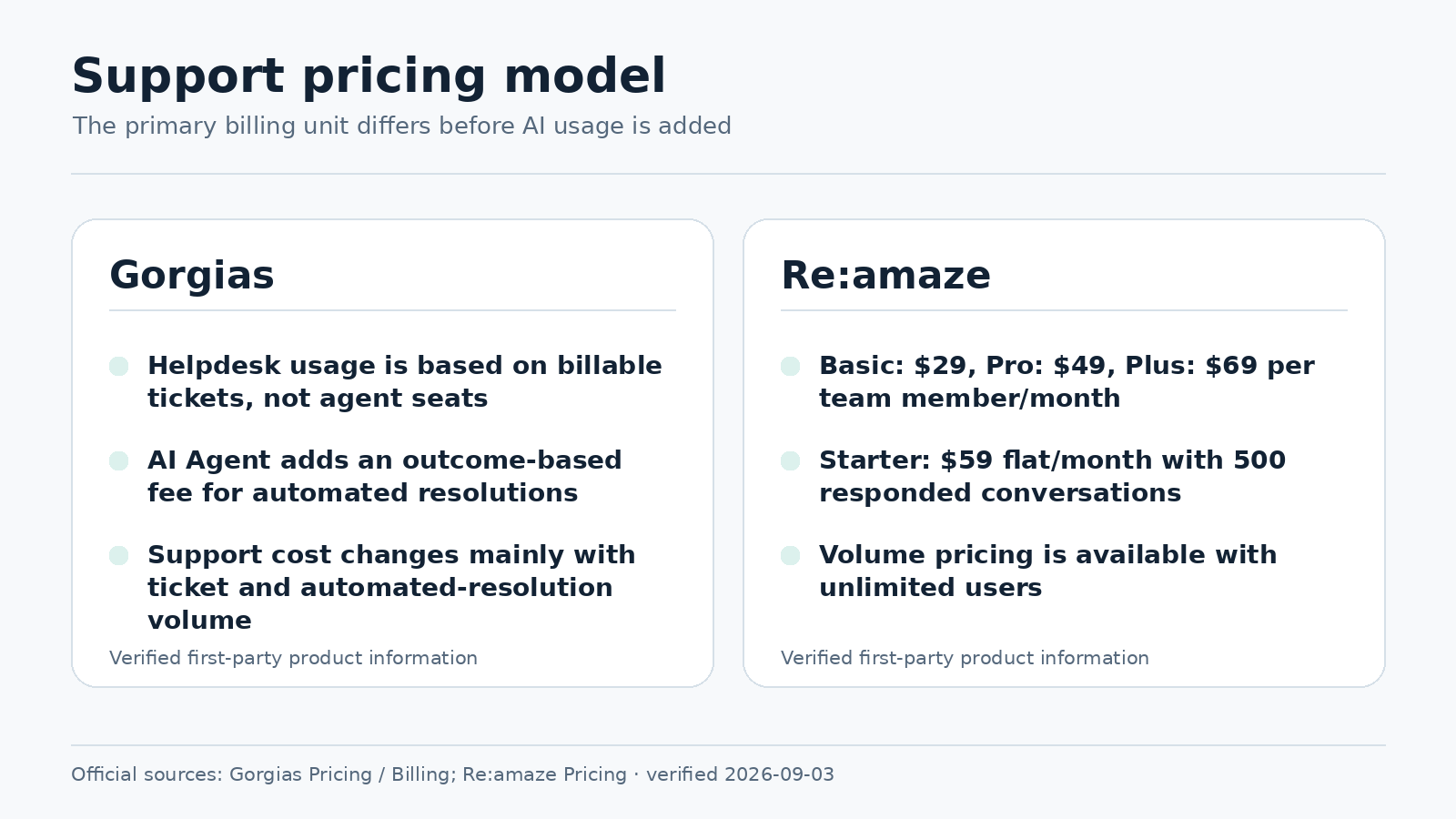
Gorgias separates helpdesk usage from AI usage: helpdesk usage follows ticket volume, while AI usage follows successful autonomous resolutions. Re:amaze offers a user-based plan structure and a conversation-volume plan, with separate AI resolution overage. These are different billing shapes rather than a basis for calling one product cheaper. A team should map its expected support organization, conversation flow, and use of autonomous resolution to the billing model it can evaluate and govern most clearly.
Verified Pricing Snapshot
Primary-source check: Official Gorgias and Re:amaze pricing and product documentation was re-verified on 2026-09-01. Pricing can change, so treat this as a dated snapshot.
| Product area | Verified snapshot | Buyer note |
|---|---|---|
| Gorgias helpdesk usage | 50 to 5,000 tickets | Ticket-based rather than priced per agent |
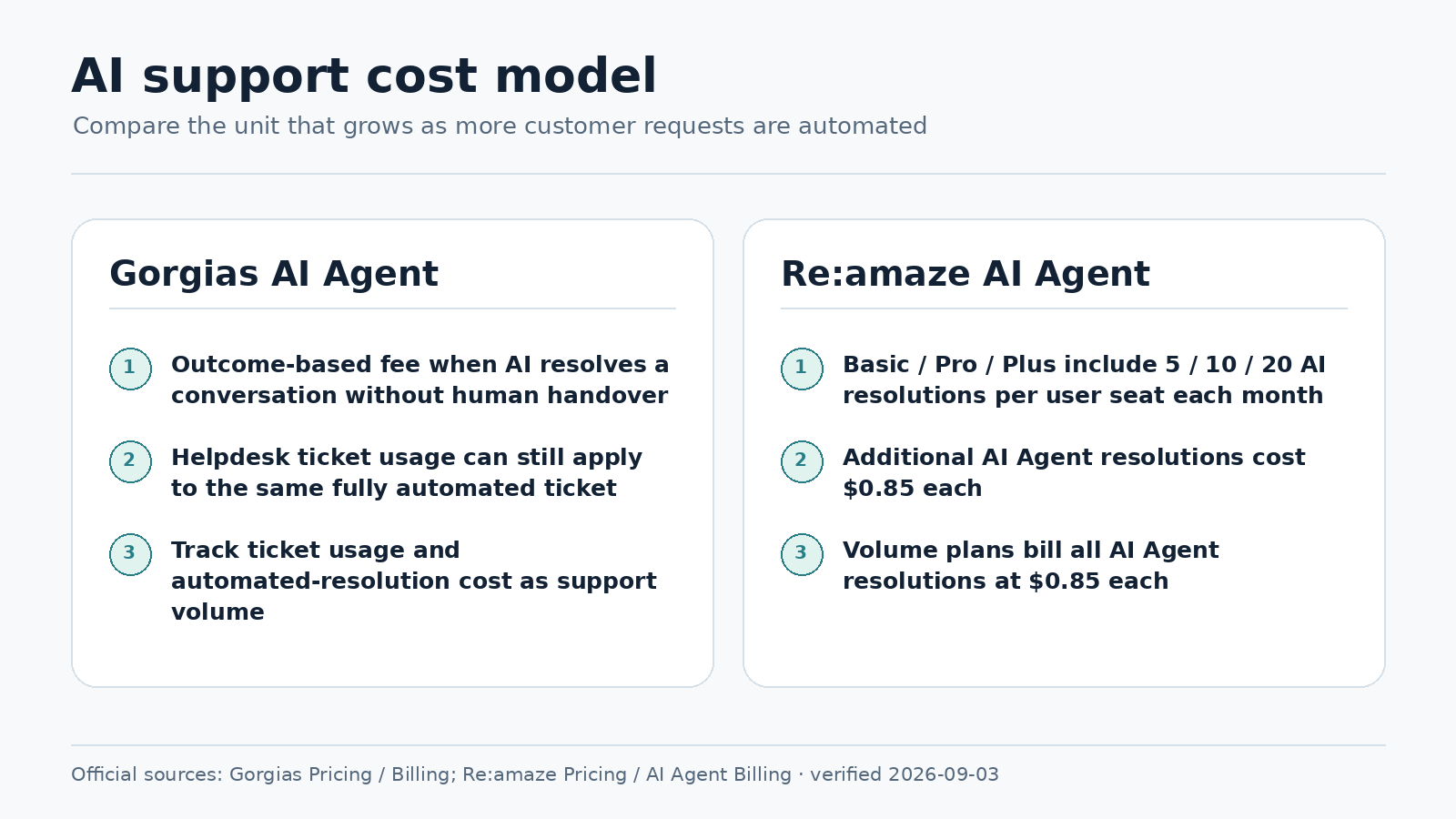
| Gorgias AI Agent, annual billing | $0.90 per resolved conversation | Successful autonomous resolutions |
| Gorgias AI Agent, monthly billing | $1 per resolved conversation | Successful autonomous resolutions |
| Gorgias trial | 30 days | Official setup documentation |
| Re:amaze Basic | $29 per user/month | User-based plan |
| Re:amaze Pro | $49 per user/month | User-based plan |
| Re:amaze Plus | $69 per user/month | User-based plan |
| Re:amaze Starter | $59 flat/month | 500 responded conversations per month |
| Re:amaze AI Agent overage | $0.85 per additional resolution | Separate AI usage driver |
| Re:amaze trial | 14 days | Official pricing documentation |
The pricing models are structurally different. Gorgias centers helpdesk cost on ticket volume and successful AI resolutions, while Re:amaze offers user-based plans plus a conversation-volume option and separate AI resolution overage. Buyers should model their own team shape and support workload.
Ecommerce Platform Fit
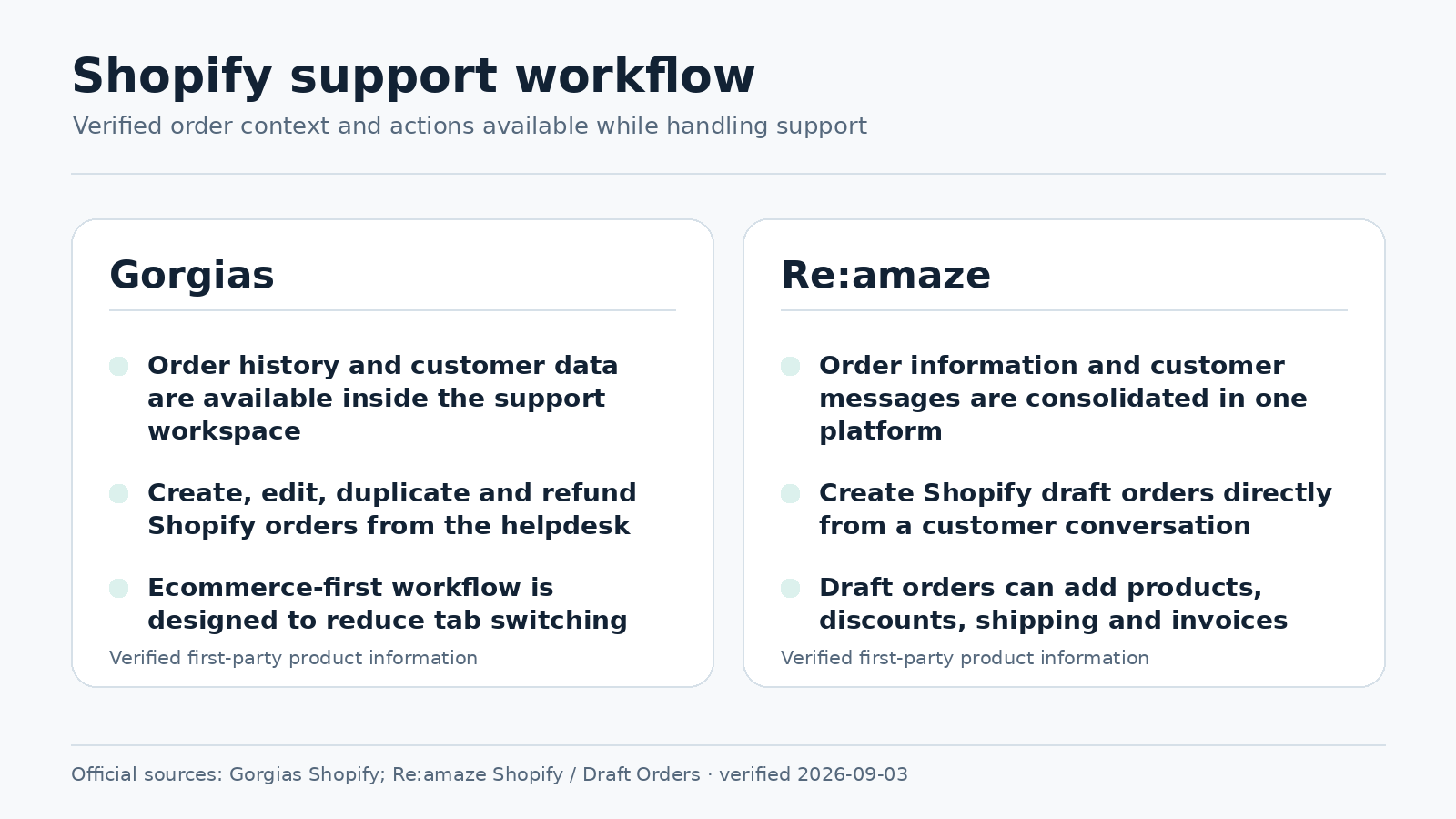
Both products have Shopify support and Shopify order management in the supplied evidence, making either relevant for a Shopify-centered ecommerce team. Re:amaze has additional documented ecommerce coverage for BigCommerce and WooCommerce, which matters for teams supporting more than one store platform or considering a broader platform mix. Gorgias is the more narrowly evidenced fit for a Shopify-first comparison, while Re:amaze presents the broader documented ecommerce context. Neither conclusion should be extended to capabilities not covered by the supplied facts.
AI and Automation
Both platforms include an AI agent. Gorgias ties AI usage to successful autonomous resolutions, giving the AI component a resolution-oriented billing and workflow frame. Re:amaze includes an AI agent and separately identifies AI resolution overage; it also documents workflow automation, which is relevant to teams evaluating automation beyond the AI agent itself. The supplied facts support comparing those structures, but they do not establish relative answer quality, automation accuracy, implementation effort, or the range of tasks either AI agent can complete.
What to Consider Before You Choose
- Whether the team’s primary store context is Shopify alone or includes BigCommerce and WooCommerce.
- Whether support is organized mainly around ticket volume or around users, conversations, and separate AI-resolution usage.
- Whether live chat, social channels, FAQ, and workflow automation are central requirements rather than secondary considerations.
- Whether Shopify order management needs to sit within the team’s chosen omnichannel support workflow—both products have this capability in the supplied evidence for Shopify contexts.
Bottom Line
Gorgias is the more concrete choice for a small Shopify-focused team that wants an omnichannel helpdesk framed around ticket volume and successful autonomous resolutions. Re:amaze is the more suitable choice for a team that values the broader documented mix of ecommerce platforms, live chat, social channels, FAQ, and workflow automation, and that can assess its user-based or conversation-volume structure alongside separate AI-resolution overage. The decision should follow the team’s support workflow and billing preferences, not an unsupported assumption that either platform is universally better.